
A beautiful destination can spark a trip in seconds. Turning that initial excitement into a workable holiday takes considerably more thought. You still need to decide whether the location fits your budget, how much travel time it requires, and what the experience might look like during your actual dates.
That gap between inspiration and practical planning is the most useful lens for evaluating Mindtrip. Rather than judging a travel product only by how appealing its recommendations look, it helps to ask whether it supports better decisions about where to go and what to investigate next.
This Mindtrip review offers an editorial assessment and a practical framework for using travel inspiration responsibly. It is not a hands-on test: current interface details, pricing, booking capabilities, and independent customer feedback have not been verified for this article. No personal travel experience or user testimonial is being presented as evidence.
You can explore the linked Mindtrip inspiration page while considering the strengths and limitations discussed below.
What Is Mindtrip?
Mindtrip is a brand in the AI-assisted travel-planning space. For this review, the specific starting point is a travel-inspiration page: a useful place to begin considering a destination, but not sufficient evidence to confirm every capability available across the product.
The distinction between inspiration and a confirmed plan matters. Inspiration helps you discover possibilities. A confirmed plan requires dates, transport arrangements, accommodation availability, realistic costs, and current information about the places you intend to visit.
Approaching Mindtrip with that distinction in mind sets a sensible expectation. Explore ideas, identify what interests you, and then validate the details that could affect your time, money, or safety.
The Practical Appeal of Travel Inspiration
Early travel research is often less about finding information than deciding which information matters. A broad search can produce dozens of attractive destinations without helping you choose between them.
A focused inspiration page gives you something concrete to evaluate. Instead of asking where you should travel anywhere in the world, you can ask whether a particular place matches the holiday you want.
Turning a Vague Preference Into a Useful Brief
Start by identifying what attracts you to an idea. Is it the landscape, the architecture, the possibility of quiet mornings, or access to outdoor activities? These are different priorities, and they can lead to very different travel decisions.
For example, wanting a scenic coastal holiday does not necessarily mean wanting a remote beach. You might prefer a walkable town with sea views, straightforward transport, and restaurants nearby. Recognizing that preference helps you assess inspiration more critically.
The practical value is not simply collecting appealing places. It is learning to describe your ideal trip clearly enough to compare realistic options.
Creating a Shortlist Instead of an Endless Collection
Travel inspiration becomes less useful when every appealing destination remains a possibility. A better approach is to keep a small shortlist and give each candidate a clear reason for inclusion.
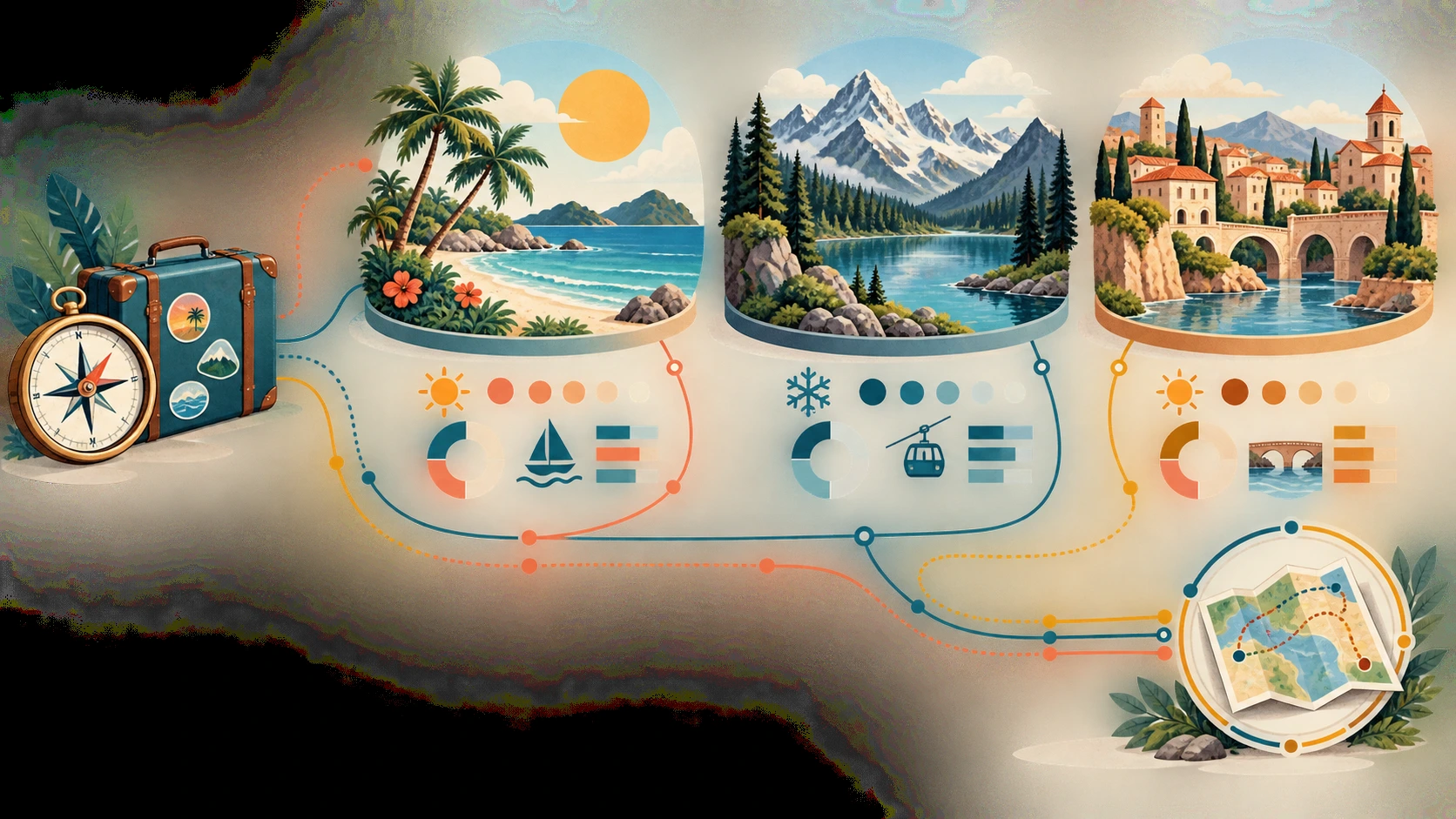
- Experience fit: Does the destination support the activities and atmosphere you want?
- Travel effort: Is the journey reasonable for the length of your holiday?
- Budget fit: Could the likely overall cost work, including transport and meals?
- Seasonal fit: Will conditions during your dates support the experience that attracted you?
- Practical fit: Does the destination meet your accessibility, mobility, or family requirements?
This framework is useful when exploring Mindtrip, without assuming the platform automatically answers every question.
Mindtrip Review: What Looks Promising and What Remains Unproven
The Strongest Use Case Is Early Exploration
The most defensible use case here is the beginning of the planning process. If you have not chosen a destination, a dedicated travel-inspiration page can serve as a starting point for identifying what appeals to you and what deserves further research.
My editorial assessment is that this is a sensible, relatively low-stakes way to explore Mindtrip. You can evaluate whether the content gives you a worthwhile idea without immediately depending on it for a purchase or a time-sensitive travel decision.
The meaningful test is whether you leave with a clearer preference. An attractive page that adds more uncertainty is less useful than a modest suggestion that helps you eliminate unsuitable options.
Visual Appeal Is Not the Same as Planning Quality
A destination can look ideal while being inconvenient for your circumstances. Long transfers, seasonal closures, difficult terrain, or limited accommodation can change the practical picture considerably.
When evaluating any travel-planning product, look beyond presentation. Ask whether the information helps you understand trade-offs and whether important details can be checked against authoritative sources.
For Mindtrip specifically, this review does not establish the accuracy, completeness, or freshness of individual recommendations. Those qualities require direct examination rather than assumptions based on the brand’s positioning.
There Is Not Enough Evidence for a Full Product Verdict
A comprehensive review would require testing the current product with realistic travel briefs and examining the results. It would also need to confirm which functions are available, whether access conditions apply, and how the product handles corrections or changing requirements.
Without that testing, claims that Mindtrip saves a particular amount of time, consistently produces accurate itineraries, or outperforms another service would be unsupported. The conclusion here is deliberately narrower: it is worth considering as an inspiration starting point, while its broader planning performance remains unassessed.
How to Make a Mindtrip-Inspired Idea More Useful
Write Down Your Nonnegotiables
Before exploring, define the constraints that would rule out a destination. These might include your departure location, available dates, approximate budget, maximum journey time, and preferred travel pace.
A useful brief could be: A relaxed coastal break with convenient transport, manageable walking distances, and enough flexibility to avoid scheduling every afternoon.
This is an example of a planning brief, not a claim about a tested Mindtrip input or feature. You can use it in your own notes to keep your research focused.
Investigate the Reason an Idea Appeals to You
When a destination catches your attention, describe its appeal in one sentence. Then check whether that experience is realistically available during your dates.

If the attraction is peaceful scenery, investigate peak-season crowding. If it is hiking, examine trail conditions and local guidance. If it is a historic town, consider whether you would enjoy the visit even if a particular attraction were closed.
This turns inspiration into a decision process rather than a collection of attractive possibilities.
Build a Realistic Outline Outside the Inspiration Stage
Once a destination survives your initial checks, sketch a simple trip outline. Include arrival and departure days, major transfers, a suitable accommodation area, and a small selection of priority activities.
Leave room for meals, rest, weather changes, and delays. A plan that looks full on paper can feel exhausting in practice, especially when it underestimates the time needed to move between locations.
If you want a concrete starting point, open the Mindtrip travel inspiration page and assess the idea against your own travel brief.
What to Verify Before Booking
Regardless of where a destination idea originates, confirm the details that can materially change your trip.
- Entry requirements: Check official guidance for your nationality, passport, and route.
- Transport: Confirm routes, operating dates, journey times, and any advance-reservation requirements.
- Accommodation: Review the actual location, room conditions, total payable price, and cancellation terms.
- Attractions: Verify opening hours, ticket availability, seasonal closures, and access restrictions.
- Accessibility: Seek specific information about stairs, surfaces, walking distances, and available assistance.
- Local conditions: Consult current weather information and relevant official travel guidance.
Use official operators, attraction websites, accommodation providers, and government resources where appropriate. Inspiration should help you decide what to investigate; it should not replace these checks.
Who Should Consider Mindtrip?
Mindtrip is most relevant to explore if you are still deciding what kind of trip you want and are comfortable doing follow-up research. It may also be a useful discussion starting point when travel companions need to compare their preferences.
It should not be treated as the sole authority for complex or high-consequence arrangements. Tight connections, substantial accessibility needs, complicated entry requirements, and expensive nonrefundable bookings all justify more detailed verification and, where appropriate, professional assistance.
A Note on User Reviews and Value
No verified customer reviews were supplied for this article, so there is no basis for summarizing user satisfaction or presenting quotations from travelers. When seeking additional feedback, prioritize reviews that describe a specific task, the dates of use, and what happened when information needed correcting.
Likewise, no current pricing or access terms have been confirmed here. Before paying for any available offering, check exactly what is included and whether it solves a problem you actually have. A travel product’s value depends less on the volume of suggestions it produces than on the quality of the decisions it helps you make.
The Verdict on Mindtrip
Mindtrip is worth exploring as a travel-inspiration starting point, but this is not a hands-on endorsement of its full planning capabilities. The useful approach is to take an appealing idea, compare it with your constraints, and independently verify the details before committing.
If you are at the exploratory stage, take a closer look at Mindtrip with one practical question in mind: does this help you move from wanting a holiday to understanding which holiday would genuinely suit you?